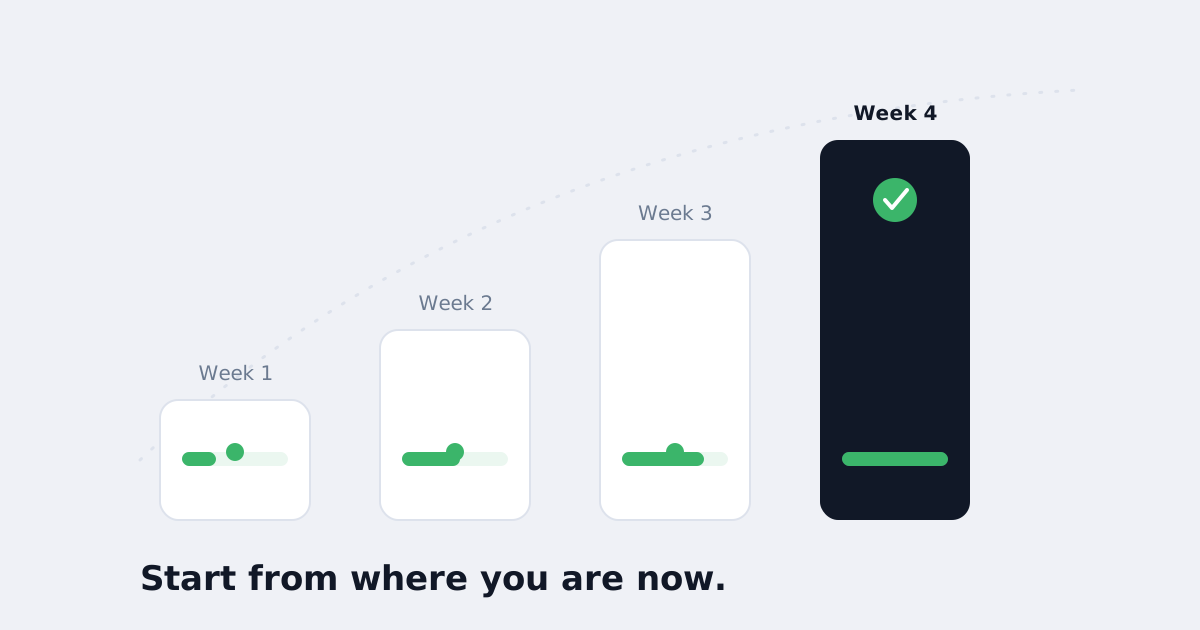
After time away from training, begin with an amount of exercise you can comfortably repeat and gradually build from there. The World Health Organization guidelines recommend this approach for people increasing their activity levels: start with small amounts and progressively increase frequency, intensity and duration over time.
Whether you've missed two weeks or several months, the aim of your first few sessions isn't to make up for the break. It's to get moving again.
What happens to your fitness when you stop exercising?
Taking time away from exercise doesn't mean all your previous progress disappears.
The loss of training adaptations after stopping or substantially reducing exercise is known as detraining. How quickly this happens varies depending on your previous fitness, the type of training you were doing, how long you've been training and the length of the break.
Research suggests that cardiovascular fitness can begin declining during relatively short periods without training, particularly in highly trained people. Strength tends to be better preserved over shorter breaks, although some training adaptations can still change.
This is why there isn't a universal rule saying that everyone who takes two weeks off should reduce their weights or training by a particular percentage.
Your return should reflect you, not an arbitrary formula.
Have you lost all your progress?
Probably not.
A break from training and returning to being completely untrained are not the same thing.
Some adaptations can decline when the training stimulus is removed, and longer periods away generally give more opportunity for detraining to occur. But a short interruption doesn't erase months or years of training overnight.
So if you've been away for a couple of weeks, there's usually no reason to treat yourself like someone exercising for the first time.
At the same time, your first workout back doesn't need to test whether you're capable of exactly what you were doing before.
What if you've only missed a week or two?
A short break might happen because of a holiday, a busy period at work, illness, family commitments or simply because training dropped down the priority list for a while.
If you've been away for a week or two, you may not need a completely new programme.
Instead, consider making the first session back a little easier and see how you respond.
That could mean:
- a shorter workout
- fewer sets or exercises
- a slightly easier effort
- more recovery between demanding sessions
There isn't a universal reduction that everybody needs to follow.
The important thing is that your first workout back doesn't have to compensate for the workouts you missed.
How hard should your first workout back be?
You don't need to prove anything in your first session.
A useful approach is to finish feeling like you could have done a little more.
That doesn't mean the workout has to be effortless. It means leaving yourself room to see how your body responds before increasing the demand again.
This is particularly useful after unfamiliar or more demanding exercise, which is more likely to produce delayed-onset muscle soreness.
For resistance training specifically, current resistance-training guidance from the American College of Sports Medicine emphasizes something refreshingly simple: complicated programming isn't necessary for most healthy adults. Consistency matters, and training can be built gradually over time.
Your first week back is therefore a poor time to worry about optimizing every detail of your programme.
Start training again first. Optimize later.
How much exercise should you do when starting again?
For long-term health, adults should work towards 150 to 300 minutes of moderate-intensity aerobic physical activity per week, or 75 to 150 minutes of vigorous activity, or an equivalent combination.
Muscle-strengthening activity involving the major muscle groups is also recommended on at least two days per week.
But there's an important distinction:
Those are targets to work towards. They aren't a minimum requirement for your first week back.
The WHO emphasizes that any amount of physical activity is better than none and recommends starting with small amounts before gradually increasing activity.
So if you've done very little exercise recently, don't turn the guideline into another reason not to start because you can't currently manage five workouts or several hours of exercise.
A 20-minute session still counts. A walk still counts. A short home workout still counts.
The first goal is getting moving again.
Should you go straight back to your old workout routine?
Not necessarily.
Your old programme was designed around your previous training capacity, schedule and circumstances. Those things may have changed.
After a short interruption, you might only need to ease back into the same programme.
After several months away, it may make more sense to reconsider things such as:
- how many days you can realistically train
- how long you have available
- the weights you're currently comfortable using
- the amount of training you can recover from
- your current goals
- whether you're training at home or in a gym
There's no prize for recreating your old routine as quickly as possible.
A programme that fits your life now is more useful than a theoretically perfect programme you can't consistently follow.
Is soreness normal when returning to exercise?
Some muscle soreness can be normal when you return to training.
Delayed-onset muscle soreness (DOMS) commonly occurs after strenuous or unfamiliar exercise and tends to become noticeable after the workout rather than during it. Research particularly associates it with unfamiliar loading and eccentric muscle actions.
This is another reason not to make your first workout back unnecessarily demanding.
And soreness isn't a scorecard.
Being extremely sore doesn't mean you had a better workout, and you don't need to chase soreness for training to be worthwhile.
Sharp or severe pain, sudden pain during exercise, significant swelling, or symptoms that concern you shouldn't simply be assumed to be normal post-workout soreness. If you're unsure whether it's appropriate to exercise, particularly after an injury or with a health condition, seek advice from an appropriate healthcare professional.
How quickly should you build your training back up?
Gradually.
There isn't one progression rule that works for everyone.
Depending on the type of exercise you're doing, progression might mean increasing:
- duration
- frequency
- resistance
- sets or repetitions
- exercise difficulty
- intensity
You don't need to increase all of them at once.
If your current training feels manageable and you're recovering well between sessions, you can progressively increase the challenge.
This approach is consistent with both WHO physical activity guidance and current resistance-training recommendations from the American College of Sports Medicine.
What if you miss another workout?
Continue.
One missed workout doesn't undo the previous ones, and you don't need to punish yourself for missing it.
Trying to compensate by cramming several sessions together can make the plan harder to maintain. Equally, missing Tuesday doesn't mean the entire week is ruined.
Move the workout. Shorten it. Adjust the week. Or simply continue with the next planned session.
A training plan should be able to survive real life.
How can you make returning to exercise easier to stick with?
Try to make the first few weeks realistic enough that you can repeat them.
That might mean training three days instead of promising yourself six. It might mean choosing 20-minute workouts because that's what your schedule currently allows. It might mean training at home rather than relying on getting to the gym.
The WHO encourages people increasing their activity to set feasible goals and choose activities they enjoy and feel confident they can maintain.
Consistency doesn't require your schedule to be perfect.
It requires your plan to have enough flexibility to keep working when your schedule isn't.
How CoachConnect handles a break from training
CoachConnect is built around the idea that your training shouldn't assume life always goes according to plan.
A short interruption and a long period away from exercise aren't necessarily the same situation, so CoachConnect treats them differently.
Comeback Mode
If you return after 7 to 20 days away from training, Comeback Mode recognises that you've had a short break.
Rather than automatically changing your entire programme, CoachConnect gives you the option of doing a reduced first session to ease yourself back into training.
If you feel ready to continue normally, you can. The choice stays with you.
Rescue Mode
After a longer period away, simply dropping you back into the exact point where you stopped may no longer make sense.
Rescue Mode helps you return at a more appropriate level rather than expecting you to blindly continue a programme created for a different point in your training.
Coach Mode
Once you're training again, Coach Mode continues learning from how your training is actually going.
Your workouts, check-ins and training history help CoachConnect adjust the plan over time.
CoachConnect doesn't just adapt your workouts while you're training. It adapts when life interrupts your training too.
We go into how that adaptation actually works in what is an adaptive workout plan.
The important part is starting again
You don't need the perfect comeback workout.
You don't need to immediately match your old weights, your old running pace or your old weekly schedule.
And you don't need to make up for every workout you missed.
Start with something manageable. See how you respond. Build gradually.
Start from where you are now.